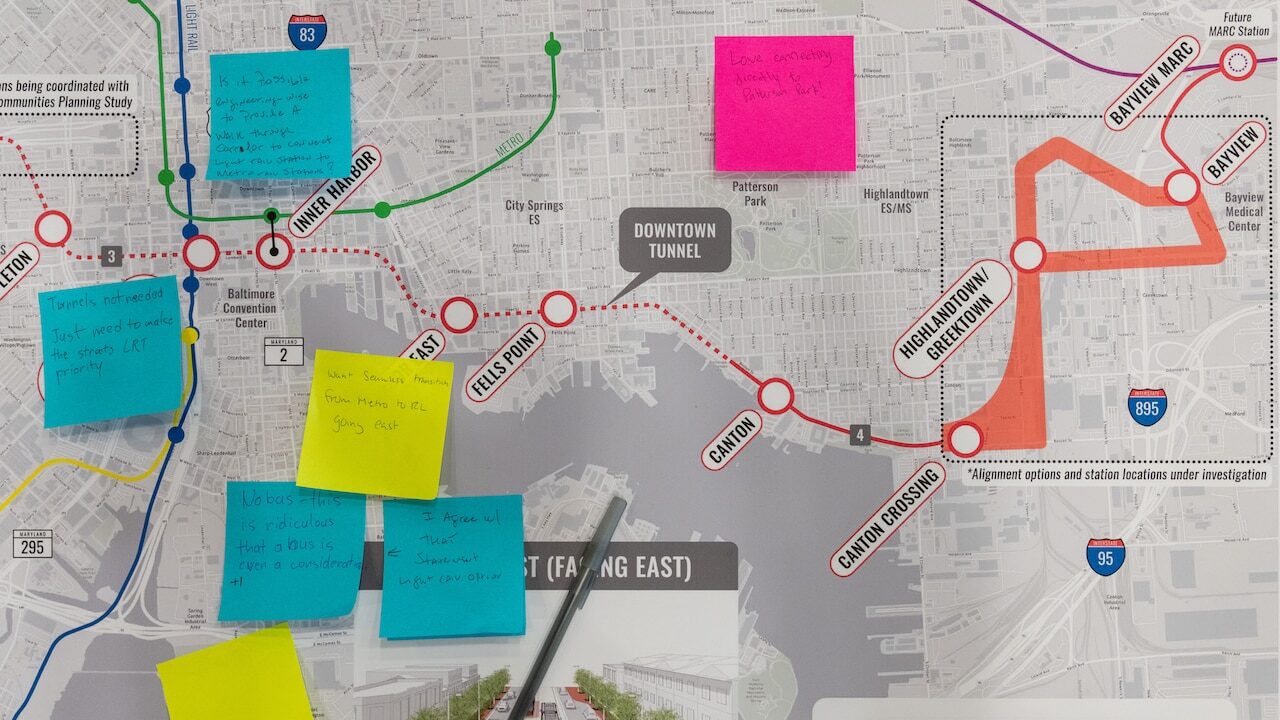
A recent study from researchers at Johns Hopkins University has revealed that Baltimore's forthcoming Red Line will significantly improve job access for residents, especially those from low- to mid-income households. The report indicates that approximately 20% of individuals living in the Red Line service area could experience a 50% increase in job accessibility, which may lead to improved economic mobility and living standards for many in the city.
The Red Line is designed to span from West to East Baltimore County, passing through downtown areas. Neighborhoods such as Woodlawn, Edmondson Village, and Clifton Park are expected to benefit the most from this transit expansion.
The research team, which included experts from Hopkins’ Department of Applied Mathematics and Statistics, utilized real-time transit data, maps, and employment statistics to create a model predicting the Red Line's impact on job access. Lead researcher Fadil Santosa expressed surprise at the extent of job accessibility improvements identified in the study.
The Red Line project, initially promised and funded by state and federal authorities, was halted by former Governor Larry Hogan but was revived last year by Governor Wes Moore. State officials are expected to soon announce whether the transit line will operate as a light rail or rapid bus system.
On Thursday, the Maryland Board of Public Works authorized an eight-year, $100 million contract with Gannett Fleming Inc., an engineering firm from Pennsylvania, to move forward with the design and environmental assessments for the Red Line project.
According to the Central Maryland Transportation Alliance, Baltimore currently trails behind other major cities, with only 8.5% of regional jobs accessible via public transit within an hour. The study from Hopkins highlights that about one-third of Baltimore residents do not own a car, underscoring the need for improved transit options.
The Red Line is projected to save commuters relying on east-west transit up to 21 minutes on their journeys. The study’s model, however, is limited by its assumption of an average vehicle speed of 20 mph, based on similar transit systems in other cities. The state has yet to finalize the route for the Red Line, with travel times varying significantly across the proposed options.
One proposed route includes a tunnel beneath downtown Baltimore, which would help avoid on-street traffic and potentially lead to quicker travel times. In contrast, surface options may face delays due to competing traffic at intersections.
Both the Hopkins report and findings from the Maryland Transit Administration suggest that the Red Line will be transformative for the region. With support from Governor Moore, Baltimore Mayor Brandon Scott, and various advocates, the Red Line is seen as a crucial development for economic growth and accessibility in Baltimore.
Reported by HarborBeat based on The Baltimore Banner (source).
0 Comments
Log in to join the conversation.