Maryland's public education system is facing scrutiny as a new report indicates a decline in the state's national ranking, despite significant increases in education funding over the past decade.
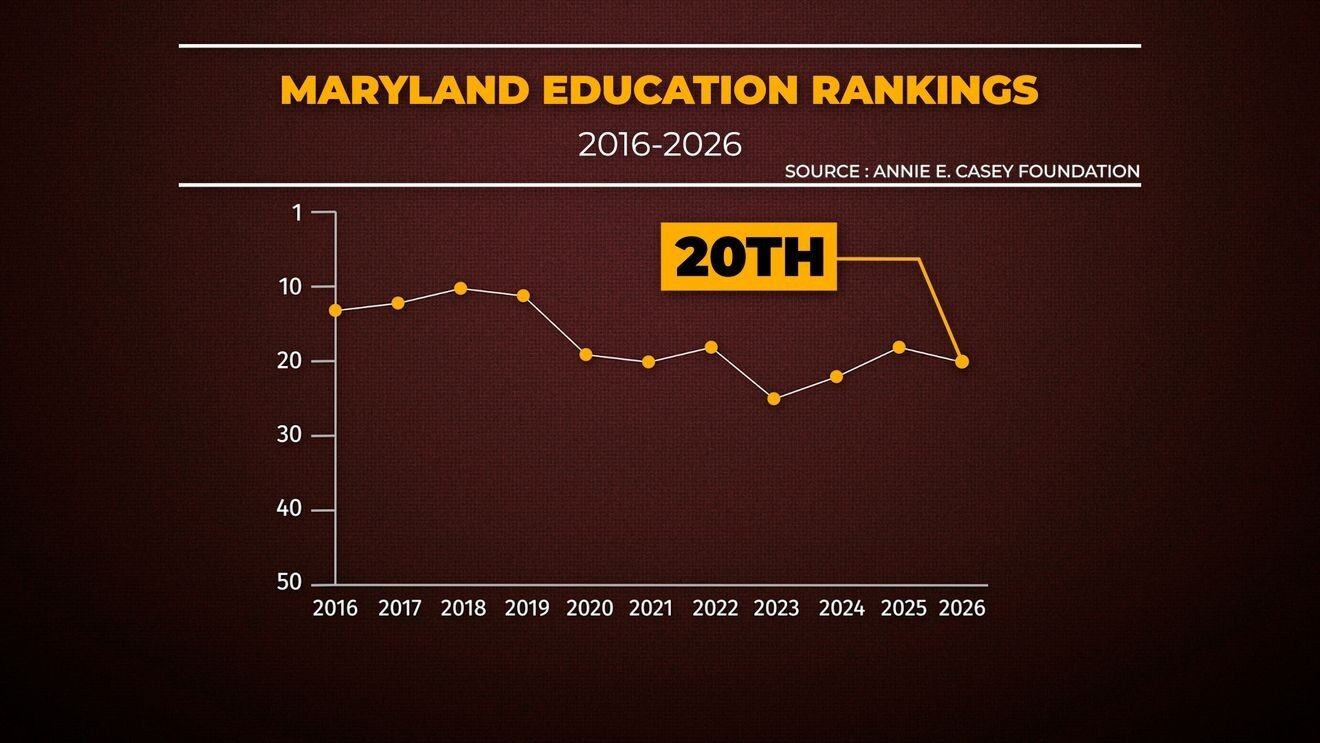
The Annie E. Casey Foundation, based in Baltimore, released its annual Kids Count Data Book earlier this month, which assesses states on various indicators of child well-being, including education. Notably, Maryland's ranking in education has slipped from 13th in 2016 to 20th in 2026, mirroring its position from 2021.
This decline comes in the wake of the Blueprint for Maryland’s Future, a comprehensive education reform initiative passed in 2021 that aimed to enhance funding for public schools. The initiative was touted as the largest increase in education spending in the state's history, with budgets for fiscal years 2023 to 2027 boosting local and state education funding from $12.6 billion to $15.8 billion.
Maryland State Delegate Kathy Szeliga, a former teacher in Baltimore City, expressed her disappointment with the findings, stating, “The results are abysmal. Instead of Maryland achieving more, we're actually declining.”
According to the Kids Count Data Book, the rankings consider factors such as preschool attendance, public school math and reading proficiency, and high school graduation rates. Despite the substantial investment in education, Maryland's performance has not improved, with schools in states like Florida, Tennessee, and Mississippi now ranking higher.
In 2024, Maryland public schools reportedly spent $20,208 per student, significantly more than Mississippi's expenditure of $12,324 per student, yet the latter's schools have achieved a higher ranking. This disparity raises questions about the effectiveness of the funding allocated to Maryland's educational institutions.
Szeliga criticized the current approach, urging lawmakers to reconsider the strategy, stating, “Putting more and more money into a system that is clearly not working is not good for students.”
As Maryland faces challenges in improving its educational outcomes, many stakeholders are calling for a reassessment of strategies to ensure that students receive the skills they need for future success.
Reported by HarborBeat based on WBFF (source).
0 Comments
Log in to join the conversation.