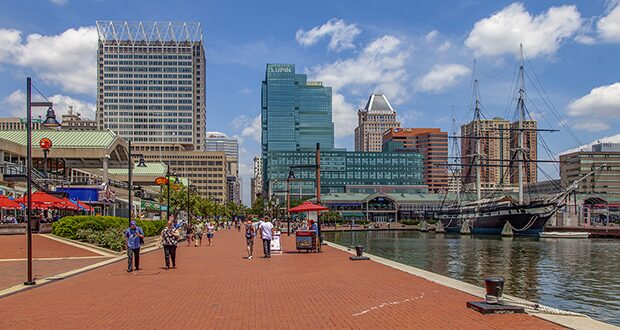
The Maryland Supreme Court ruled on Friday that Baltimore City is not immune from a negligence lawsuit filed by a cyclist injured on the Inner Harbor Promenade in 2018. This decision overturns the city's previous claims of immunity under the Maryland Recreational Use Statute.
In a unanimous opinion delivered on July 17, the court clarified that the statute, which is intended to encourage property owners to allow public access by limiting tort liability, does not apply when the property serves a transportation function.
Justice Steven Gould articulated that the Recreational Use Statute does not exempt local governments from common law liability when public property is utilized for transportation purposes, even if activities such as biking are also considered recreational.
The case stemmed from an incident involving Jamie Wallace, who was biking home from work along the promenade in June 2018 when her tire became lodged between the brick path and the granite bulkhead, causing her to fall into the water and sustain injuries. Wallace filed her lawsuit in August 2019, and a jury awarded her $100,000 after ruling in her favor.
Following the jury's decision, Baltimore City sought to overturn the verdict, arguing that it had no duty of care towards Wallace. However, the circuit court dismissed this motion, stating that the city's interpretation of the law could lead to an unreasonable outcome where the city would be completely immune from liability for injuries occurring on city streets.
The Maryland Appellate Court upheld this ruling in February 2024, noting that the promenade serves as a vital connector within the city's infrastructure, not merely as a recreational area.
Justice Gould emphasized that the city’s reasoning could potentially apply to all city streets, which would contradict the statute's intended purpose. He pointed out that the promenade is recognized in Baltimore's Bicycle Master Plan, further solidifying its role in the city’s transportation framework.
In a concurring opinion, Justice Jonathan Biran proposed a two-part test to better navigate the complexities of the statute's application in cases where properties serve dual purposes.
Wallace was represented by Curtis Cannon from the law firm Goldberg Finnegan.
Reported by HarborBeat based on Maryland Daily Record (source).
0 Comments
Log in to join the conversation.